How to Repair Old Clothes Instead of Throwing Them Away
Most people toss a shirt the moment a seam splits or a button disappears. That reflex costs real money and fills real landfills. The average American throws away about 81.5 pounds of clothing each year, while a survey by Rawshot.ai found that only around 21% of U.S. consumers attempt to repair their clothes to extend their lifespan. That number is surprisingly low when you consider how easy most fixes actually are.
What You're Really Throwing Away
Before getting into the how-to, the numbers are worth sitting with for a second. Global textile waste hit 120 million metric tons in 2024, and 80% of it ends up landfilled or incinerated. Most garments are worn fewer than 10 times before being discarded.
Research from WRAP [1], the global environmental action NGO, found that for every five items repaired, four displace a new purchase entirely. Repairing one cotton t-shirt instead of buying a new one saves over 7.5kg of CO2, equivalent to ironing continuously for 25 hours.
And the financial math is just as compelling. A tailor charges anywhere from $10 to fix a button to around $50 to hem pants. Spending $40 to take in the waistband on a good pair of pants could save you 60% to 80% over buying new ones. For a quality blazer or wool coat, that math gets even more obvious.
What Goes Wrong Most Often (and What to Do About It)
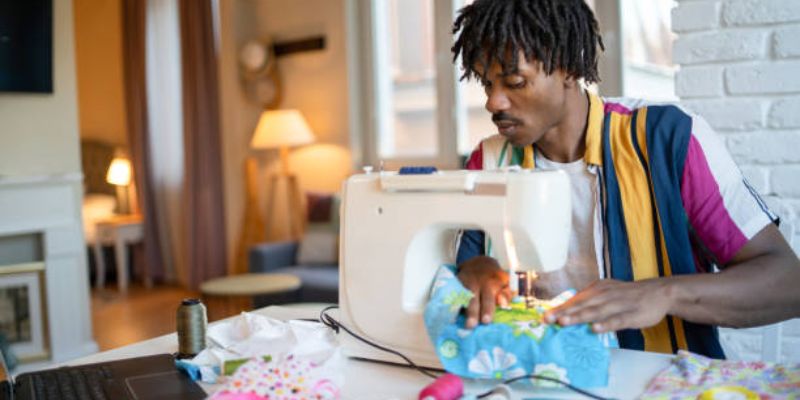
Most clothes don't die a dramatic death. They fail quietly: a seam pulls apart, a zipper gets stuck, a moth finds a sweater. Each of these is fixable at home with minimal skill and about $10 worth of supplies.
Here's a realistic breakdown of the most common clothing problems and how to repair them.
Popped Seams: The Easiest Fix in the Wardrobe
Seams are the first thing to give out, especially on cheaper garments where thread tension wasn't great to begin with. A seam split along the back of a pair of trousers or under the arm of a shirt feels catastrophic in the moment, but it's one of the simplest repairs there is.
All you need is a needle, matching thread, and about 10 minutes. A whip stitch works well for pesky seams, and a backstitch offers extra reinforcement when you need the repair to hold under tension. Run the stitch back and forth past the original seam line by at least half an inch on each side so the thread anchors into intact fabric.
For machine users, a zigzag stitch along the seam line is faster and arguably stronger. If the seam allowance is thin (a sign of low-quality construction), reinforce it with iron-on interfacing on the inside before re-stitching.
Missing Buttons: Quicker Than You Think
Buttons are the repair that intimidates people the most and takes the least time once you've done it once. A sewing kit from any drugstore runs around $3 to $5 and contains everything needed. Most garments come with spare buttons sewn into the care label or inner seam.
Thread the needle, knot one end, push through the fabric from the inside and out through one buttonhole, then down through the opposite hole. Repeat five to six times. Wrap the thread around the base of the button a few times to create a shank (this gives the button room to sit flat when fastened), then knot off on the inside.
For heavy fabric like wool coats or denim jackets, place a small flat button on the inside of the fabric directly behind the main button. This distributes the pull and prevents the fabric from tearing over time.
Holes in Knits and Sweaters: Darning
Darning is the technique most people associate with their grandmother's sewing basket, and there's a reason it survived for generations. It works.
Darning involves weaving a patch using thread or yarn. It's more common to darn knits like sweaters and patch woven materials like jeans. For a basic darn, you need a needle, matching yarn or thread, and something round to hold the fabric taut while you work (a tennis ball, a glass, or a proper darning mushroom if you want to commit to it).
The process: stitch parallel rows across the hole, leaving loose threads to cover the gap. Then rotate 90 degrees and weave perpendicularly, going over and under those first threads like a tiny loom. The result is a woven patch that blends into the knit structure. It sounds fiddly until you try it once, and then it clicks.
For a moth hole the size of a coin or smaller, this takes under 20 minutes. For larger damage, a contrast-color yarn turns the whole thing into a deliberate design choice rather than a visible repair.
Ripped Jeans and Fabric Tears: Patching
Patches get a bad reputation because people picture the iron-on kind that peel off after three washes. Those work fine as a temporary fix, but a sewn patch lasts years.
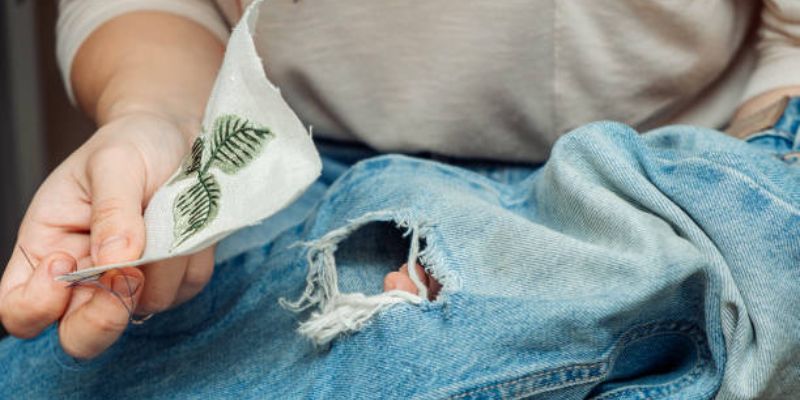
Cut a piece of suitable fabric with 1.5 inches added to both the length and the width of the hole, then turn under the raw edges and pin it over the damaged area before stitching firmly by hand or machine. Cutting the patch larger than the hole matters: you want the stitches landing on solid, intact fabric rather than on the edges of the damaged area.
For jeans specifically, denim from an old pair (or a cheap thrift-store find cut up for scraps) is the ideal patch material. It wears at a similar rate as the original fabric, which keeps the jeans looking cohesive. Place the patch on the inside, stitch parallel lines across it from the outside with matching or contrasting thread, and the repair is visible but intentional.
The visible mending movement has reframed patching as styling rather than damage control. Bright embroidery thread stitched in geometric patterns across a denim patch looks deliberate in a way that a bare rip never does.
Broken Zippers: Fixing Before Replacing
A broken zipper usually means one of three things: the pull has detached, a tooth is misaligned, or the slider has worn down. Of these, the first two are home fixes. The third usually requires replacing the slider, which a tailor can do for around $10 to $15.
For a pull that's come detached: thread a small key ring or a piece of cord through the slider hole. It's functional immediately and takes about 30 seconds.
For a zipper that keeps sliding open: squeeze the slider very slightly with pliers. Zipper sliders loosen over time and lose their grip on the teeth. Gently pressing the two sides of the slider closer together re-establishes the tension. This fix works about 80% of the time.
For a stuck zipper with a broken tooth: rub the teeth with a bar of soap, a graphite pencil, or a dry lubricant. If a single tooth is bent, use tweezers or pliers to coax it back into alignment. Missing teeth are harder to fix at home and may need professional help.
Pilling on Sweaters and Knits
Pilling is not damage in the structural sense. The fabric is intact; it's just that surface fibers have tangled into small balls from friction. A fabric shaver (sometimes called a lint shaver or defuzzer) removes these in minutes and costs between $10 and $25.
Go over the pilled area with slow, light circular strokes. Don't press too hard or you'll snag threads. Empty the shaver's chamber regularly so it doesn't get clogged. After one session, the sweater looks closer to new than anything short of actual replacement would achieve.
Frayed Collars and Cuffs
This is where most shirts get written off prematurely. Wearing a garment 50 times instead of fewer significantly reduces its environmental impact per use by 400%. A shirt with a slightly frayed collar still has plenty of life left if the fix is approached correctly.
For collars: remove the collar entirely by cutting the stitches attaching it to the neckband, then flip it 180 degrees so the unworn underside becomes the top. Reattach. This is the classic collar-turning technique that tailors have used for decades, and it essentially doubles the collar's lifespan.
For cuffs that have frayed at the edge: cut away the frayed portion (usually 3 to 5mm), fold under a clean hem, and top-stitch it down. The cuff will be fractionally shorter, which is rarely noticeable.
When to Take It to a Tailor
Some repairs are genuinely worth paying someone else to do, particularly on garments where the fabric is delicate, the construction is complex, or the repair needs to be invisible. Lining replacement in a coat, reweaving a snag in a suit jacket, or re-covering a tailored button falls into this category.
Hemming pants typically runs $10 to $50 depending on the fabric and tailor, while fit adjustments like taking in a dress often cost between $20 and $75. These prices are meaningful when weighed against the cost of replacing the item, especially for anything that originally cost over $100.
The general rule: if you paid significantly for the garment, if it fits your body in a way that's hard to replace, or if it has sentimental value, the repair cost is almost always worth it. If it was a $15 fast fashion piece that's already stretched and pilling, repairing it is a harder case to make.
Building a Basic Repair Kit
You don't need a full sewing room to handle 90% of home repairs. A small kit covering the basics goes a long way:
A pack of assorted hand sewing needles, spools of thread in black, white, navy, and grey (these cover most neutral garments), small sharp scissors, a seam ripper, iron-on interfacing for reinforcement, a fabric shaver, a few iron-on hem tape strips for emergency fixes, and a darning mushroom or any smooth rounded object if you wear a lot of knitwear.
Total cost for assembling this from scratch: under $30. That kit will handle hundreds of repairs over years of use.
The Bigger Picture: Wearing Clothes Longer Actually Works
Extending clothing life by nine months reduces carbon, water, and waste footprints by 20 to 30% and saves an estimated £5 billion in resources used to supply, launder, and dispose of clothes [2].
That's not a small number for an individual action. Repairing is not about being precious or anti-consumption for its own sake. It's about getting the most out of what already exists, not replacing things before they've earned their keep.
The clothes sitting in your wardrobe with small, fixable damage are not waste yet. They're 10 minutes away from being useful again.
References
[1] WRAP – The Waste and Resources Action Programme – https://www.wrap.ngo
[2] Earth.Org, Fast Fashion Waste Statistics – https://earth.org
Related Posts

Plus Size Workwear Guide Office Outfit Ideas That Flatte
The Evolution of Casual Work Attire for Women and Modern Office Style Trends
Boho Wedding Dresses Guide Popular Styles, Fabrics, and Tips for Choosing the Perfect Dress

The Benefits Of Sustainable Sportswear: Comfort, Performance, And Sustainability
Plant-Based Leather: Sustainable Alternatives To Traditional Leather